

Scientists have uncovered a surprising natural anomaly and determined the invisible barrier that causes jellyfish to disappear en masse from the ocean’s surface after every heavy downpour.
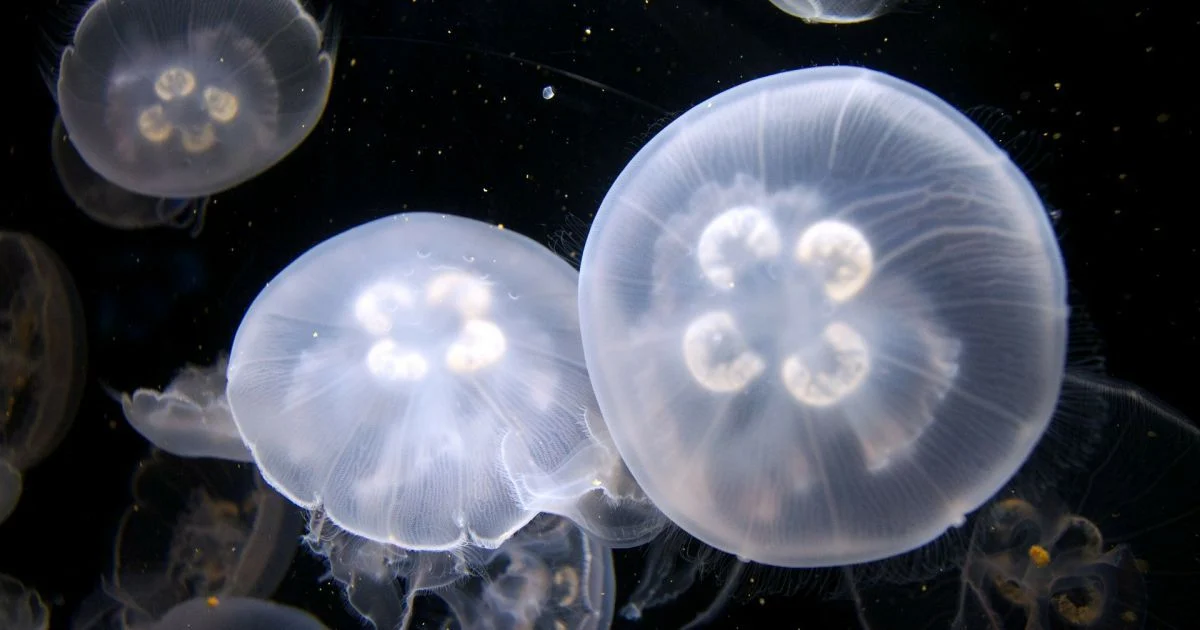
After downpours, jellyfish cannot reach the surface due to a barrier created by rainwater / © pixabay.com
Jellyfish typically swim very close to the water’s surface in search of food, guided by sunlight. However, after heavy rains, these creatures suddenly vanish from the upper layers of water bodies, descending much deeper. Scientists have managed to explain this anomalous behavior of marine organisms using basic laws of physics.
Phys.org reports on this remarkable natural phenomenon and its unexpected explanation.
Unexpected Discovery
A team of German scientists traveled to Everglades National Park in Florida to collect box jellyfish of the species Tripedalia cystophora. These creatures possess complex eyes and exhibit interesting behaviors, but after a tropical downpour, the researchers couldn’t find them at all in their usual shallow waters. This sudden disappearance prompted scientists to replicate similar conditions in their own darkened laboratory.
The cause of this behavior was water stratification, which occurs along the coast after abundant rainfall. Lighter freshwater forms an upper layer over denser saltwater, and a transitional zone called a halocline forms between them. Using artificial intelligence, scientists observed that the jellyfish constantly tried to break through this barrier towards the light but failed repeatedly.
A Physical Barrier, Not Biology
Previously, it was believed that organisms simply avoided certain zones, or that changes in salinity temporarily impaired their swimming abilities. However, the new study proved that while actively moving upwards, jellyfish displace denser saltwater into the lighter layers. This process creates what is known as stratification resistance, which rapidly depletes the animals’ energy and significantly reduces their buoyancy.
It turns out that jellyfish create additional resistance for themselves through their own movements, making it physically impossible to cross the halocline. According to the study’s authors, this invisible boundary operates under the same principles as electronic transistors, controlling the medium’s conductivity. Thus, the vertical distribution of an entire population of animals in the wild is dictated purely by the physics of boundaries, rather than their physiology or behavior.
We remind you that the coast of Western Australia was swarmed by a school of deadly box jellyfish. These creatures may belong to a new species that does not yet have an official name.
Comments Sort by: New Old Popular Send