

The frontline remains under intense strain, yet the situation is no longer as critical as during the grueling winter battles.
War in Ukraine / © Associated Press
Ukraine has managed to contain the spring offensive of Russian forces, and a cautious optimism has emerged on the front lines in recent weeks.
This is reported in a piece by The Washington Times.
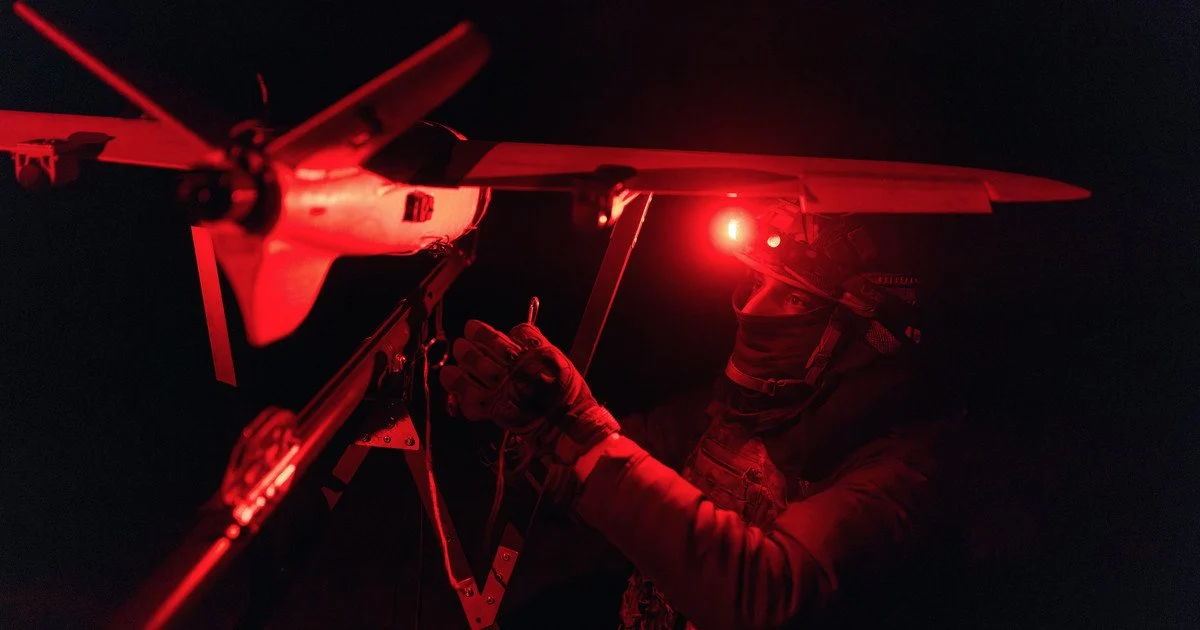
According to the publication, one of the primary factors has been Ukraine’s active utilization of drones and modern combat technologies.
“The situation has improved slightly,” said drone pilot Ihor from the 423rd separate UAV battalion.
He noted that while the frontline is still under considerable pressure, the circumstances are not as dire as they were during the arduous winter engagements.
The article emphasizes that the very structure of the battlefield has significantly transformed. The front line is no longer confined to trenches and traditional defensive positions.
Brave1 CEO Andriy Hrytseniuk explained that a so-called “zone of destruction” has formed around the front.
“A so-called ‘zone of destruction’ has formed around the frontline, the depth of which was previously estimated at approximately 20 kilometers, where vehicles can no longer operate effectively due to the mass use of drones,” he stated.
According to Hrytseniuk, this zone is gradually expanding due to Ukraine’s deployment of medium-range drones, which enable precise strikes deep into Russian positions.
This, the publication suggests, has become the foundation for the new, cautious optimism on the Ukrainian side.
Ukrainian military personnel observe that although the Russian army still holds the initiative in certain front sectors and continues to actively employ manpower, artillery, and drones, an increasing number of attacks are being thwarted before the occupiers can even approach Ukrainian positions.
The situation remains particularly tense in the southern Zaporizhzhia region. Russian forces are conducting reconnaissance in the vicinity of Huliaipole, which Ukrainian commanders consider one of the potential avenues of advance towards Zaporizhzhia.
“They want to cut off the route to Zaporizhzhia. For them, Huliaipole is the direct path,” said Vitaliy Hersak, commander of the 423rd separate drone battalion of the Armed Forces of Ukraine.
He mentioned that Russian military personnel are attempting to use the spring foliage for covert movement of infantry through forest strips—on foot, on motorcycles, and on quad bikes.
Meanwhile, Ukrainian UAV units have prepared in advance for such attacks.
Another hotspot remains Kostiantynivka in the Donetsk region. Russian forces have been trying to approach the city, which is part of Ukraine’s eastern defense belt, for several months.
In early May, Reuters reported that fighting was already occurring near the city’s outskirts, with Russian units positioned less than a mile from its southern districts.
However, the publication stresses that despite the serious pressure, the scenario of a frontline collapse, feared last year, has not materialized.
“They attack, but we hold the defense,” said Horb, a drone operator from the 28th brigade of the Armed Forces of Ukraine.
Ukrainian officials explain that technology has become the primary reason for the front’s resilience. Drones are no longer a secondary element but have transformed into a key factor in the war.
At the same time, Kyiv maintains a reserved assessment of the situation. Despite significant losses, Russia still possesses an advantage in human resources, ammunition, aerial bombs, and industrial capabilities.
The Ukrainian infantry remains fatigued, and authorities continue to seek avenues for personnel replenishment and rotation.
Nevertheless, as The Washington Times concludes, the dynamics on the front have noticeably shifted in recent weeks: Russia continues its advances in specific directions, but the cost of each kilometer for the occupiers is steadily increasing.
It was previously reported that Ukrainian military personnel are stating a change in the situation at the front.
We previously informed that Robert “Madjar” Brovdi warned that the zone of regular strikes near the front can now extend up to 25 kilometers or more on both sides of the contact line.
Comments Sort: New Old Popular Send