

Under hundreds of meters of Antarctic ice, scientists have discovered a complex topography not visible from the surface. It was explored by the autonomous submarine Ran, which subsequently disappeared without a trace beneath the Dotson ice shelf.
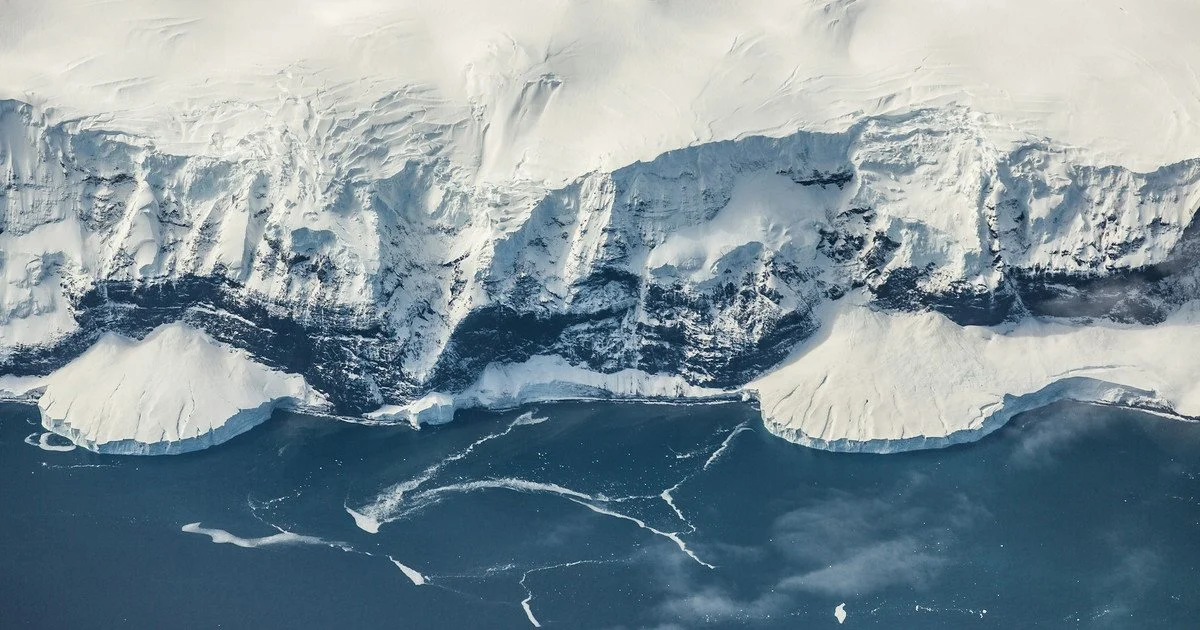
Exploration under the Antarctic ice / © unsplash.com
The orange autonomous underwater vehicle Ran submerged beneath hundreds of meters of ice in West Antarctica, where satellite navigation and continuous communication with a vessel are unavailable. During the 2022 mission beneath the Dotson ice shelf, the 7-meter submarine recorded previously unknown topographic features.
In 2024, the same submarine made a return dive and vanished without a trace. This was reported by the Daily Galaxy.
Robotic Submarine Recorded Anomalous Topography Under Antarctic Glacier and Disappeared
During the 2022 research, the Ran vehicle submerged under the ice for 27 days. The vehicle covered over a thousand kilometers and penetrated 17 kilometers into the cavity of the Dotson glacier. Using an upward-facing multi-beam sonar, the submarine measured ocean currents, temperature, and water salinity.
Some dives lasted over a day. The research team was led by Professor of Oceanography at the University of Gothenburg, Anna Wåhlin, and scientists from the International Thwaites Glacier Collaboration. The mission’s objective was to map the underside of the glacier.
In January 2024, scientists returned for repeat scans, but after the very first dive, the submarine did not resurface.
The multi-beam sonar of the Ran vehicle created six high-resolution maps covering an area of approximately 140 square kilometers. The study, published in Science Advances, revealed significant differences in the patterns and rates of melting across various sections of the glacier.
The eastern and central parts featured terraces ranging from 200 to 2,000 meters wide with steep steps from 0.5 to 5 meters high. Individual terraces formed multi-level systems with elevation changes of 5 to 40 meters. Scientists attribute these formations to slow melting, convection, and periodic influxes of warmer water.
The western region appeared smoother, with clusters of teardrop-shaped depressions recorded, invisible from the surface. The largest specimens had an average width of 68 meters.
Wåhlin’s team determined that intense melting was caused by turbulence and the influx of modified water. The researchers suggest that friction and the Earth’s rotation may have contributed to their asymmetrical shape.
The sonar also detected through-going rifts, the oldest of which appeared on satellite images of the surface as early as the 1990s, while the youngest were estimated to be between 2 and 5 years old.
Another study in 2025 provided new data on the hydrodynamics beneath the Dotson glacier. Scientists collected data along over 100 kilometers of the seafloor. The authors of the paper noted that the Dotson glacier contributed approximately 0.6 millimeters to the global sea level rise between 1979 and 2017.
Scientists were unable to repeat the measurements and compare the changes. In February, during the last scheduled task, Ran did not return to the rendezvous point beneath the glacier. Search operations using acoustic devices, a helicopter, and drones yielded no results.
Scientists believe the submarine likely remained deep beneath the ice shelf, and the 2022 maps remain the only detailed snapshot of this hidden topography.
Therefore, to this day, researchers who find something interesting deep underwater do not fully know what exactly they have found.
Underwater Discoveries: Latest News
We recall that in eastern China, beneath the waters of Qiandao Lake, lies the ancient city of Shicheng, founded during the Eastern Han Dynasty. In 1959, this developed regional center with a clear layout was intentionally submerged during the construction of a hydroelectric power station and the creation of a reservoir.
For over 60 years, the city has been at a depth of 26 to 40 meters, and due to its unique level of preservation, it is often compared to the mythical Atlantis.
The underwater environment protected the structures from the effects of wind, rain, and sun, transforming into a natural protective barrier. Thanks to this, city streets, temples, gates, stone arches, stairs, and exquisite carved images of dragons and phoenixes have been remarkably preserved to this day. Researchers and divers confirm that the architectural details remain clear and intact even after half a century since submersion.
Comments Sort: New Old Popular Send