

The Black Sea has turned turquoise, and this is clearly visible in satellite images from NASA. Scientists explain that such a phenomenon is related to the mass blooming of a specific type of phytoplankton.
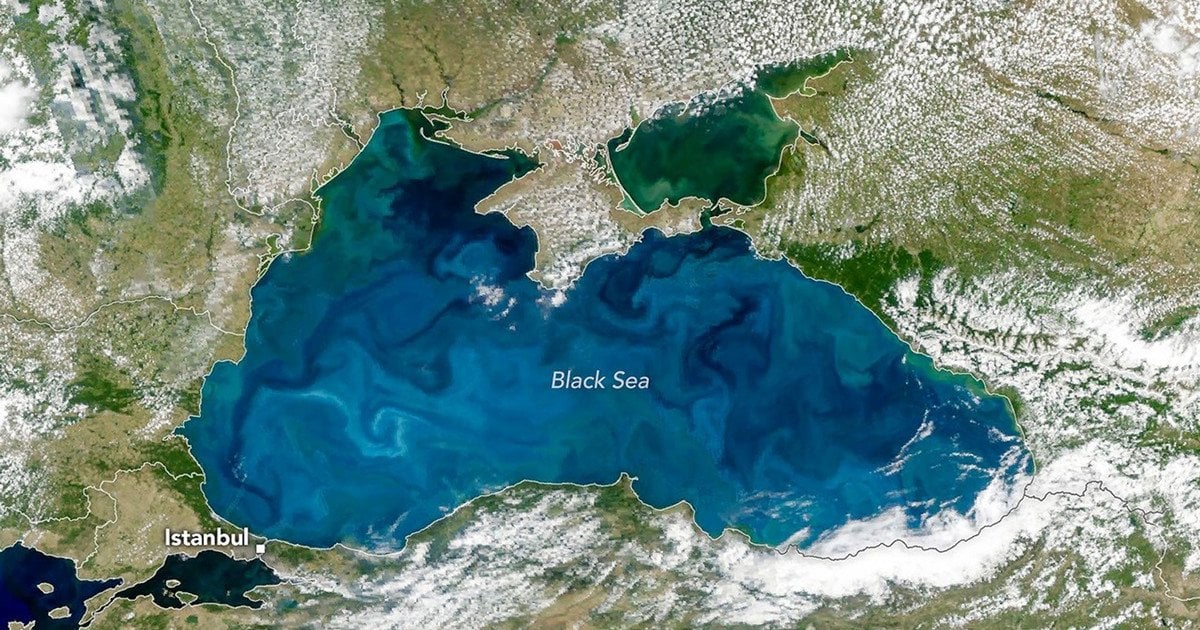
Black Sea on June 22 / © NASA
Every spring and early summer, the Black Sea changes its usual dark color to a bright turquoise due to the massive blooming of phytoplankton. It was precisely this natural phenomenon that the NASA PACE satellite captured.
NASA reported this, publishing a satellite image obtained using the Ocean Color Instrument (OCI) installed on the PACE (Plankton, Aerosol, Cloud, Ocean Ecosystem) satellite on June 22. The image shows that a significant portion of the Black Sea surface has taken on a rich turquoise hue.
NASA explained that the unusual water color is likely caused by coccolithophores — a type of phytoplankton covered with calcium carbonate plates. It is these microscopic organisms that, during mass blooming, can give the sea surface a milky blue or turquoise color. They most often dominate in the body of water in late spring and early summer.
In other seasons, the situation changes. According to NASA data, diatoms — microscopic algae with silicon shells — become more common in the Black Sea. Unlike coccolithophores, they do not lighten the water but rather make it darker.
The Bosphorus, a narrow strait passing through Istanbul and connecting the Black Sea with the Sea of Marmara, has also turned turquoise. As early as May 27, 2026, an astronaut aboard the International Space Station photographed phytoplankton blooms in the strait. The image showed how currents carried it along both sides of the waterway.
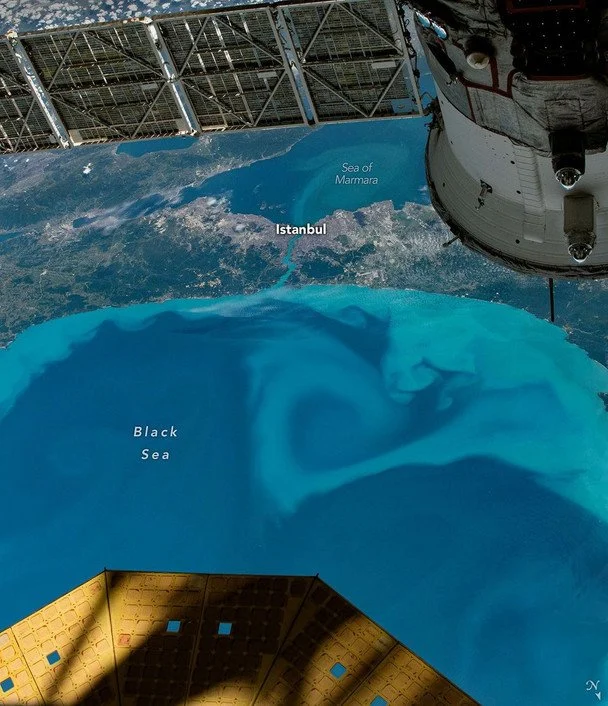
Black Sea on May 27 / © NASA
NASA explains that despite the microscopic size of coccolithophores, during mass blooming, their concentration becomes so high that the change in water color can be seen even from satellites. This is precisely why space observations help scientists track the spread of phytoplankton, especially in areas where it is difficult to regularly collect water samples.
In addition to the visual effect, such blooms are important for the ocean’s carbon cycle. When coccolithophores die, some of the carbon they absorbed settles to the seabed, where it can remain for a very long time.
We remind you that earlier we reported that the Tuzlovskiye Limany National Nature Park reported mass dolphin deaths in the Black Sea. 56 dead animals were recorded in a month. Additionally, cetaceans with signs of contusion were found near Odesa.
Comments Sort: New Old Popular Send