

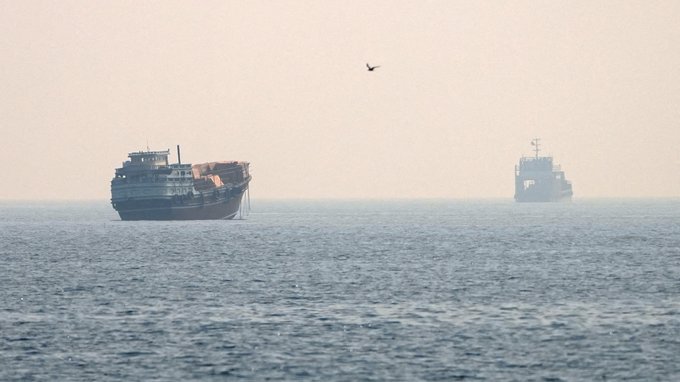
The 60-day memorandum between the United States and Iran, signed on June 18, expires on August 17. In it, the parties agreed to conclude a final agreement to end the war. Now Iran is threatening escalation in the Strait of Hormuz.
This is reported by Reuters.
According to the publication, the Iranian government is “preparing for escalation in the Strait of Hormuz and throughout the region.” Iran will also “launch a military attack to break the U.S. naval blockade” if diplomacy fails.
“Within the short period of a few weeks set by Iran, the United States must fulfill all provisions of the agreement. This is a prerequisite for further negotiations with the United States,” the Iranian government stated.
U.S. President Donald Trump stated that Iran must surrender. “Iran must raise a white flag of surrender,” Trump told reporters.
President Trump also threatens Oman, another Middle Eastern country. Trump stated that the United States would “bomb the death out of” Oman if the country interfered with America’s control over the Strait of Hormuz. Oman has access to the Strait of Hormuz and has been negotiating with Iran on the management of the strait.
On June 18, the United States and Iran signed a memorandum of understanding aimed at ending the war in the Middle East. The signing took place remotely.
According to the document, the United States and Iran undertake to immediately cease all military operations, including hostilities in Lebanon, and to refrain from using force or threatening each other in the future. The draft provides for the conclusion of a final agreement within 60 days.
The text also contains extensive economic commitments from Washington. In particular, the United States must gradually lift all sanctions against Iran, grant permits for the export of Iranian oil, unblock frozen Iranian assets, and facilitate the implementation of Iran’s economic recovery program worth at least $300 billion.
What is known about the ceasefire termination between the U.S. and Iran
On July 6, Iranian forces launched missile attacks on commercial vessels in the Strait of Hormuz, hitting at least two tankers.
On July 7, the UK Maritime Trade Operations Center (UKMTO) stated that a tanker was attacked by an unknown drone while in the Strait of Hormuz.
In the morning of July 8, U.S. Central Command forces launched a series of strikes against Iran in response to attacks on commercial vessels in the Strait of Hormuz. CENTCOM reported “high-precision strikes on more than 80 targets” – Iranian air defense systems, command and control networks, coastal radar stations, anti-ship missile systems, as well as over 60 IRGC boats in and near the strait.
The IRGC stated that the Iranian Navy and Air Force attacked 85 U.S. military facilities located in Bahrain and Kuwait.
On July 8, at the NATO summit, Trump announced that the ceasefire with Iran was no longer in effect. At a press conference after meeting with the President of Ukraine, he warned of the possibility of new strikes on Iran and stated that the United States might restore the naval blockade of the country.
Trump also said that American troops had already struck the Iranian island of Kharg, a key oil export hub, and did not rule out strikes on power plants and water desalination facilities.
On July 9, the United States Armed Forces launched new strikes against Iran to weaken its ability to threaten freedom of navigation in the Strait of Hormuz. The U.S. stated that this was to hold Iran accountable for attacks on commercial vessels and civilian crews.
On July 12, U.S. Central Command forces launched a third series of strikes against Iran in a week: this time in response to an attack by the Islamic Revolutionary Guard Corps (IRGC) on the container ship M/V GFS Galaxy, which was transiting the Strait of Hormuz under the Cypriot flag. Attacks on Iran continued on July 13.
Source: suspilne.media