

Your device does not support media playbackPlay video, “Whirlpools on the Sun revealed by super-telescope”, Duration 0.2900:29
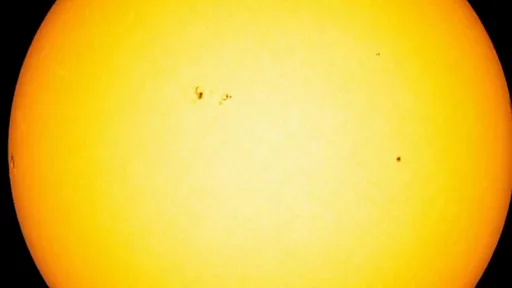
Video caption, New images have revealed details previously unseen
The most powerful solar telescope has allowed scientists to observe the Sun’s surface with unprecedented detail for the first time. In the new images and videos, they have seen enormous swirling streams of hot gas – a kind of fiery vortex – which had remained invisible until now.
These are believed by researchers to be the source of powerful solar storms that can sometimes disable satellites, affect power grids, and pose risks to astronauts.
Researchers state that they have now witnessed a process that was previously hidden.
“The Sun is the source of all this energy and all space weather,” explains David Boboltz of the US National Solar Observatory (NSO).
The more scientists learn about the processes within the Sun, the more accurately they will be able to predict space weather.
“If we want to learn to predict it, we have to understand the physics of the Sun – down to the smallest details,” he says.
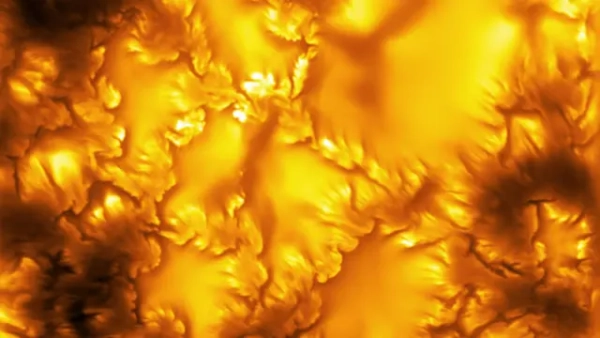
Photo credit, NSF/NSO/AURA/MPS
Photo caption, The most powerful solar telescope has revealed new details of the Sun’s surface
What no one has seen before
The findings of the research have been published in the journal Nature.
The unique images were obtained thanks to the Inouye Solar Telescope, located high in the mountains of Hawaii.
The clear air and lack of dust there create ideal conditions for observation.
During multiple magnifications of the Sun’s surface, scientists discovered numerous small, constantly rotating vortices.
“These swirling currents generate magnetic energy that can accumulate and eventually lead to massive explosions,” astronomer David Curidze from the National Solar Observatory told BBC News.
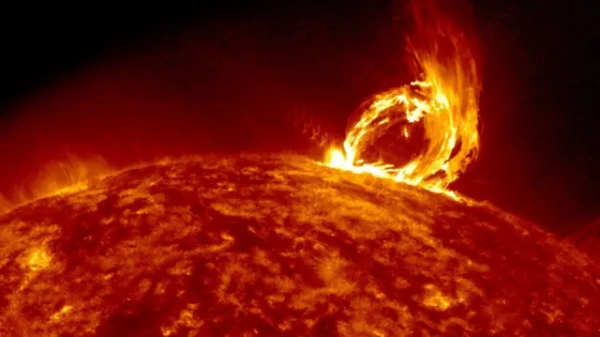
Photo credit, NASA/SDO
Photo caption, Scientists hope these images will help better understand the nature of solar flares
Why this discovery is important
Scientists call this phenomenon Kelvin-Helmholtz instability.
It occurs when two streams of hot gas move at different speeds. At the boundary between them, small waves initially appear, which gradually spiral into vortices.
A similar process can be observed on Earth – for example, in the ocean, where a small ripple gradually transforms into large waves.
According to another NSO employee, Dr. Friedrich Wegner, the discovery not only helps understand how space weather originates but also brings us closer to answering another long-standing question: why the outer layers of the Sun heat up to such high temperatures.
“When enough energy accumulates in the upper layers, it can be suddenly released in the form of a solar flare or a so-called coronal mass ejection,” he says.
Such phenomena can disrupt the operation of satellites, communication systems, and power grids on Earth.
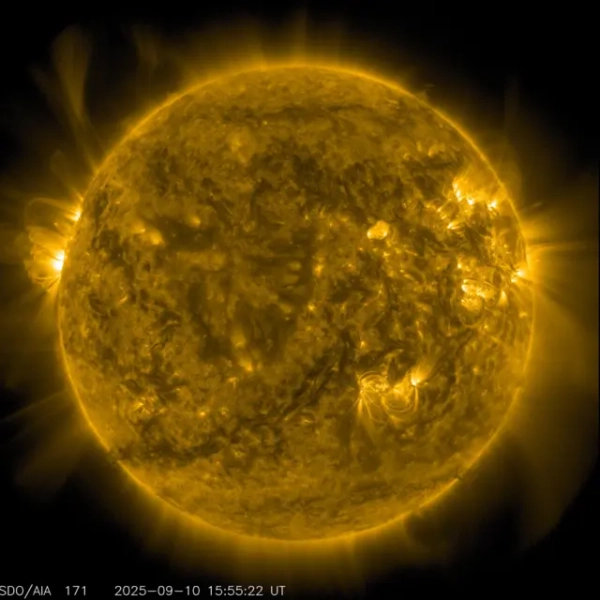
Photo credit, NASA
Photo caption, The NASA image shows a powerful plasma eruption from the Sun’s surface
However, practical significance is not the only reason to study the Sun, Boboltz emphasizes.
“It is a unique natural laboratory. The closest star to us helps test the most fundamental laws of physics.
It was during the observation of a solar eclipse that Einstein’s general theory of relativity was first experimentally confirmed.
Therefore, such research is necessary at least to expand the boundaries of human knowledge,” the scientist concluded.

Photo credit, NSF National Solar Observatory
Photo caption, The Inouye Telescope is located high above the clouds, where the clear air provides almost ideal observation conditions
Джерело